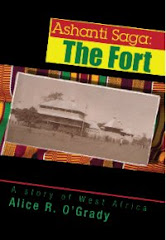
If you’re interested in Africa and want to know more about West Africa but don’t like non-fiction books, here’s an historical novel for you.
It’s a story about Kofi, a 17-year-old member of the Ashanti tribe in what is now central Ghana. In 1900, when the story takes place, it is part of the British colonial system.
Kofi goes to hear the British governor, who was visiting from the coast to give a speech. In it the governor tells the Africans they will have to pay certain fees, that their kidnapped chief will not be returned to them, and he demands to sit on the Golden Stool. These and other pronouncements infuriate the Ashantis, and they go to war.
Kofi, who does not believe in violence, is caught up in the war with many misgivings. He is very fond of Trudi, a school friend and the daughter of one of the missionaries, and doesn’t want her to suffer.
The Africans besiege the Kumasi fort in which the governor, his wife and son and British soldiers are residing and in which Swiss missionaries have taken shelter. In the fort, Trudi befriends Paul, the son of the governor, and the young man also is attracted to the self-centered girl.
The siege continues for more than two months, after which most of the Europeans escape. Before they part, Trudi promises to wait for Paul to finish his college studies.
Kofi has become intensely anti-European, and vows to spend his life as a freedom fighter.
Most of the events and characters, with the exception of Kofi, Trudi and Paul, are historical. I was fortunate in that the British governor’s wife published a book in which she described life in the fort during the siege, so I have not only historians’ accounts of the Ashantis’ conduct of the war, but an insider’s view of the besieged.
Ashanti Saga: The Fort is a Young Adult book, but adults of all ages enjoy reading it. It is available at Amazon and BarnesandNoble.com.
BOOK TOUR
I’m currently on a tour of Florida, Texas, California and the Pacific Northwest (and points in between) from mid-January to mid-April. I am speaking, giving PowerPoint presentations about West Africa and signing my book along the way.
RETURN TO AFRICA
I first went to Ghana in 1961 as a member of the first U.S. Peace Corps group to go to work anywhere in the world. I taught science there for two years, and in 1964 I became Deputy Director of the Peace Corps in Ibadan, Nigeria. In 1968 I went back to Ghana to teach in Accra, leaving in 1972.
Early in 2008 I was contacted by some former students at the the high school in Accra, who informed me they were endowing a scholarship at the school and naming it “The Alice R. O’Grady Award for Excellence in Science.” They presented me with a round-trip ticket to Ghana so I could go to Accra and present the first award to a student at the school, which I did in September, 2008.
Just to let you know that I AM working on the sequel to Ashanti Saga: The Fort. Its working title is Ashanti Saga: Change of Plans.
This novel takes place in 1922, and the main characters are offspring of some of those we met in 1900 in the first novel. A young soldier travels to Ghana from his native England, and there he has the experiences that fill the remainder of the book.
The story begins with his family in England, and you will recognize his parents if you've read The Fort. Then his trip by sea to the Gold Coast, and his adventurous disembarking at Takoradi.
He is posted to Kumasi, where he falls in love. That's all I'm going to reveal to you; the book should be published by spring of 2013.
Can one in all honesty write a diary after finishing a trip? I think not. So, as I hope to be in Chautauqua tonight, I'd better write about my journey since Minnesota.
Madison, WI is where my fellow Ghana 1 Bob Klein and former Nigeria PCV Phyllis Noble live. They had a party at which I spoke, and I also spent a morning at Sennett Middle School, talking to three groups of children about West Africa. Enjoyed both, but I do love speaking to children, though they generally don't buy books.
Klein/Noble's neighborhood has a plethora of ethnic restaurants, and I enjoyed Indian and Thai meals there, as well as a surprisingly good pizza and Bob's doctored spicy tomato soup.
Spent my 75th birthday with them, a leisurely time with no schedule, no obligations. That's the way a birthday should be.
Took a slight detour to Milwaukee, where I stopped at the Omanhene Chocolate Company U.S. headquarters to meet Steve Wallace. He has a factory in Tema, Ghana that produces chocolate, which he sells in the U.S. and Japan. I bought a bunch of his small chocolate bars and have been giving one to everyone who buys my book.
Had lunch near Chicago with my sister-in-law, Betty O'Grady, catching up with family news. A night in South Bend, IN and I'm now near Cleveland, and shall head home almost immediately.
After Ellensburg, WA I drove through Idaho: farmland with a great advantage.The names of the crops were posted on the fences along the highway! No more "I wonder what that is growing there" in Idaho! Even though, in March, there wasn't much growing anywhere.
The weather forecasts and my friends warned me that a big snowstorm had hit the Dakotas and Nebraska, so I stayed in Billings waiting to see which way was better: 90 through N.D. or 94 through S.D. The next day, south looked a little better, so I took off, through a corner of Wyoming and then east. The days were sunny and the roads perfectly clear, with an occasional wet spot.
In Wyoming I was pleased to see a herd of antelope. I recall people hunting them when I lived in Thermopolis; brought back memories. Don't think I ever ate one, for which I'm grateful after seeing these graceful animals.
A lot of the driving in South Dakota was through hills (mountains?) that were bare and brown or tan. Maybe there were dead grasses. When one is at the crest of a hill, looking down at more hills, one has that on-top-of-the-world feeling. You can never get that when there are trees around.
In Minneapolis I had a new speaking experience: I spoke in an art gallery. It was an exhibit of the beautiful metalwork of Rabi Sanfo from Burkina Faso, just north of Ghana. I had an interested crowd, and sold more books than usual.
The gallery is owned by former Nigeria PCV Lynn Olsen and her husband Frank Stone, who is also a metal artist. They own the gallery building and rent space for other artists and craftsmen's workshops. They've watched the somewhat run-down neighborhood change to one occupied by artists side by side with the ethnically mixed population. Had a great few days with them, had a look at the city and the Mississippi River, and went into the Guthrie theater complex. Interesting building.
My friend Laura Damon has long been interested in chimpanzees, and she mentioned in an email that I was near the Chimpanzee & Human Communication Institute in Ellensburg, WA. I stopped there, attending a 1 1/2-hour "chimposium" in which I learned a lot about chimps and observed the three residents using American sign language to each other and to humans. What an experience that was!
I encourage everyone to take advantage of this opportunity when possible. The Web site is http://www.cwu.edu/~cwuchci/.
Driving east from Ellensburg I encountered snow--but not on the road. For much of the rest of my trip so far there has been snow on the ground. Seeing it among the conifers on the mountainsides was beautiful, and once a recent snowfall had dusted the branches. Such glorious sights I've seen!
Visiting my niece Jessica Burstein in Seattle was fun, as I hadn't seen her in years, and I enjoy her company. We ate (and drank) at several good restaurants in her neighborhood, and had a lot of conversations.
I'd broken a tooth on the way there, and her dentist glued it back together (a temporary measure) that turned out to be QUITE temporary, as it came loose about an hour later as I gently ate. So now I'm gap-toothed again.
With the help of Dr. Joe Appiah-Kusi I visited two schools, and another that Jessica had arranged for. Didn't actually speak (except briefly to one class) at Seattle Girls' School, but had a fascinating tour of the place. The syllabus is really interesting, and as it's a private school it can make education more meaningful, environmental and effective than is possible in the public bureaucracy.
Back to Portland for hosts Laura and Jonathan's party and to again enjoy their one-year-old, Hadley. I spoke at the party and showed some of my artifacts.
My drive to Ellensburg, WA was one of the most beautiful of the whole trip, through The Dalles along the Columbia River. At times the road and the river were at the same level, with cliffs enclosing us on both sides. Even an occasional waterfall!
In Auburn, CA, about an hour's drive NE of Davis, I visited Arlene Bouman. We had been roommates in the late '50s, and seen each other only once since then, about 39 years ago. What a treat to see old friends and catch up with THEIR lives!
Arlene lives in the foothills of the Sierra Mountains, and from her deck all one sees is miles and miles of ponderosa pines and the mountains in the distance. I was able to unwind there after all my urban experiences.
I spoke at a school library in Grass Valley that's also a public library. I didn't get any details on how that works, but it seems a reasonable arrangement in this era of library consolidations and closings.
What followed was a LONG drive to Portland, Oregon, where I stayed the night with Laura and Jonathan Stanfill on my way to Seattle. Lots of orchards and nut farms along the way, many of them in bloom.
The hills outside San Francisco, in my memory, were always brown; Herb Caen called them cornflake hills. But on this trip, after days of rain, the hills were all green and lush. On the way to Davis, near Sacramento, the land became flat farmland: miles and miles of it.
My first engagement in the Davis area was at the home of Cynthia Brantley, an African Studies professor at the university. She had invited six graduate students, all doing research projects in Africa, to come hear me talk. I hoped that what I was saying was new to all of them some of the time, and they seemed interested.
In Davis I stayed with Jeannette Hogan, whom I knew when she was a PCV in Nigeria. She had arranged for me to speak at the Avid Bookstore in Davis and in Sacramento as well as at a class at a community college. In Sacramento, the only attendee was my old friend Mike Shea from my Peace Corps Ghana group, so we sat and talked for an hour, and then Jeannette and I packed up and went home. I was SO glad Mike came, or I would have been disheartened.
In contrast, my talk at the Avid Reader in Davis was attended by 16 people, and it turned out that Jeannette had personally invited every one of them. It takes that contact, not newspaper or radio advertising, that brings people.
In that college town, it seems that bicycles are almost as numerous as cars, and I saw at one intersection the traffic signals included a crossing in any direction for bikes while all other traffic stopped. A bicycle was pictured where one might usually find a "walk" signal.
Outside Davis I visited the Jepson (Jephson?) Prairie vernal pools. The soil there is clay, so dense that water does not filter through it. Rainwater therefore collects in depressions until it evaporates. The varieties of plants that grow around the edges appear in succession as the water recedes, so one gets a "bathtub ring" effect. In a few weeks, I was told, there would be concentric rings of wildflowers dotting the landscape. I was a bit too early; what I saw was the pools.
As Jeannette is taking a class in Japanese massage, I was treated to two massages in my three days there, as a practice subject. What a treat!
No, not THAT kind of religious experience; those of you who are acquainted with me and my Freethinkerism know better than that. But I did attend a religious service at which Ken was a paid choir member. Not unpleasant; I always love to sing the old hymns, and the choir was pretty good.
But the technology! The words to the hymns and the responsive reading were projected by PowerPoint successively on the front wall of the church. But the biggest surprise was during the sermon, when the pastor asked us to watch a brief video that was shown on this space as well. What a boon to sermonizers!
The point of the video was to show us that we see what we're looking for, and little else. It was a basketball game, and we were asked to count how many times one team passed the ball. Afterwards he asked if we'd seen the gorilla, and nobody had. When he ran the video again, there it was: a gorilla joining in the game. Good lesson.
The drive from Santa Cruz to San Francisco was as delightful as I remember it. The beautiful sunny weather helped, of course, but the scenery is magical. Much of the time on Route 1 the Pacific Ocean is in view, and I determined that the whitest white I have ever seen is the color of the foam as waves break against a rock. Fields of yellow wildflowers, grasses and craggy Monterey pines dotted the roadside, with rocky ledges overlooking the sea.
The day after I arrived, my host Ken Malucelli and I walked out on Mori Point. It was quite a hike up from Pacific Beach, but well worth the climb, which was mostly on steps that have been built into the hillside. The typical pastel homes of this area marched up and down the hills, and we could see Mt. Tamalpias north of San Francisco and as far south as Half Moon Bay. Beyond the Farallone Islands (about five miles off the coast) I think I even saw a little bit of Tokyo as well.
Well, it was more than momentary--about 15 horrible minutes, actually. I had driven to friends' for dinner, and was returning to my old friend Lawrence Stern's condo, when I took a wrong turn. I've taken lots of wrong turns, esp. on this trip in strange neighborhoods, but this was a REALLY wrong turn, onto a railroad track. I stopped immediately, and my Honda Civic hybrid, which I love dearly, would subsequently move neither forward nor back, with a tire spinning on the track as if it were on ice.
I called 911 and stood out in the drizzle with many cars passing me by, though my stuck Honda was clearly visible. I was frightened that a train would come along at any moment and destroy my vehicle. After about ten minutes (the highway patrol had not yet appeared) a car did stop, with two men and a woman, all Hispanic with little English. They couldn't budge my car until another man stopped, and together they pushed me back onto the road.
When I told Lawrence about the incident he informed me that the trains don't run at night. Would have saved a lot of adrenaline had I known that before!
The next day I wrote a letter to the editor of the local newspaper to thank them, as I had done so in a rather perfunctory way the night before. I do hope my Good Samaritans read it and know how grateful I am.
I'm reminded of a long-ago incident when a female friend and I had a flat tire at night in L.A. and three young Hispanic men came to our aid. One of them said, "My mom would kill me if I told her I'd passed by two ladies in distress." Is there something in the Hispanic culture that encourages this?
The Social Security Administration was once my employer, and in Los Angeles I returned to the organization, but to the El Segundo branch. This is not an office that directly serves the public, but deals with cases sent to it. What a difference between that and my old Crenshaw office! This one is much smaller, with, it seemed, much more friendly and cohesive staff. They all put down their forms and their mice and listened to my PowerPoint presentation about West Africa, after which they had prepared a delicious potluck lunch. A former colleague from Crenshaw, Anne Sekino, had arranged my visit as she now works at El Segundo, and she had arranged for a surprise visitor: Eleanor Williams, a former colleague of ours, whom I had not been able to get in touch with. What a pleasant surprise!
That was the only booking I had in the L.A. area, but I spent the rest of the time meeting old friends for lunch or dinner. I hardly had any meals with Sara Meric, my host in Santa Monica. Had a wonderful Indian meal at the home of an Indian-Ghanaian former student, along with another former student. Met my nephew James and his wife Ana at a restaurant, and got to see my great-niece Caitlin for the first time. What a lovely, sweet baby!
Another interesting drive: Tucson to the San Diego area. West of Tucson the desert changed completely to a SANDY desert, which I hadn't seen before. Like in the movies we watched as kids. Then hills covered with boulders that looked like huge potatoes and little vegetation. Once over the hills I noticed how lush the growth was becoming, and it became moreso as I approached San Diego. Such greenery! I appreciated it with green-starved eyes, but also kept thinking of how much water it took to keep it that way.
Stayed with my friend Fern Gordon in nearby San Marcos, and she threw a wonderful luncheon after which I spoke and sold some books. Also spoke at Oceanside Library one evening. About 10 teenagers and an equal number of adults (half of them friends of mine) attended, but by half-way through all the teens had left. What a testament to my winning ways with words! I was told that some of them had to get home before it was very late, which was some comfort.
The drive to Los Angeles was long, on a crowded freeway, but there were some lovely views of the Pacific Ocean. I'm so glad I don't have to drive in such traffic at home.
Driving to Tucson from El Paso showed me an interesting change in landscape. Whereas El Paso's desert is dry with scattered scrubby plants, approaching Tucson I saw sajuaro cacti, tall and noble, often with one or more "arms," which don't start to grow until the plant is at least 50 years old. Other, shorter cacti were visible. On a vist to the wonderful Desert Museum I learned a lot about these and other living things of the desert.
I stayed with former Peace Corps Volunteer (Turkey) Jackie Day in Milagro (Miracle) Co-Housing Community whose unifying principle is "To live lightly on the land." Interesting place: about 28 residences, some of them duplex, occupied by young families with small children up to retired folks. Each house has a solar unit on the roof that provides heat for the water supply, and large tanks are at each house to catch rainwater off the roof. Their grey water is piped underground to a "wetland" where a certain kind of reed has been planted to clean the water. The black water from toilets eventually goes there too, after settling. All this is piped back to water the plants in the community, most of which are local and therefore don't require much water. But they do have some citrus and fig and some other fruit trees, I think.
One would expect to see a community garden there, but as with almost any community with voluntary membership, there are a few who don't want to go along with the majority, and there is no garden, though some individuals do grow vegetables on their own property.
I attended a vegetarian dinner at the home of another resident and talked to about ten women about West Africa, showing my artifacts. Ten-year-old resident Emily modeled carrying a baby on her back.
At a thrift shop in Florida where I had hoped to buy a baby doll for such demonstrations I learned that baby dolls can't be sold unless they are tested for lead in the paint. So my "baby" is a teddy bear.
It's been a long time since I was in a school, but I got a good dose this past week here in El Paso, as I talked to three schools in three days. Two of my experiences were with LITTLE kids, pre-K to 5th grade, who assembled in their schools' libraries; I talked to six groups each day and showed an abbreviated version of my PowerPoint presentation. I sold about ten books to teachers in those two days, and had a great time. The kids enjoyed dancing the African hilife.
The third day I was in a high school, speaking in the auditorium to four different groups of humanities students. Also a good day. Their questions and responses were more insightful and interesting, but few of them danced.
I'm looking forward to Tucson tomorrow, as I'll be staying with a returned Peace Corps Volunteer (Turkey) in an Intentional Community, but they call it co-housing. As friends at home are hoping to establish such a community, I'm interested in seeing how this one is organized.
You guys up north think you have a corner on the snow market! Driving from Ft. Stockton to El Paso, up in the mountains, there was snow, but the wind was blowing so hard it didn't get a chance to land on the ground. Actually, snow in El Paso is not unusual.
The wind carried dust and tumbleweeds with it that reminded me of my years in Wyoming.
That same wind was a headwind for me, and I'm sure my hybrid used about a gallon of gas for every 15 or 20 miles, as opposed to its usual 39 mpg. I was surprised when the fuel signal came on, and had to drive about 50 more miles to find a gas station, coasting down hills to save gas. The gas at that little outpost on the prairie was $2.22/gallon, but it saved my hide.
Am staying with my nephew Daniel and his family. His wife Sandra is a teacher, and she has arranged for me to speak at three schools in three days. Today I was at a K-5 school, and spoke to six different groups of little kids, 1/2 hour each. It was fun! Am also enjoying my two great-nephews, ages nine and two.
Just as the pandhandle of Florida is in Central time, the panhandle of Texas that's El Paso is in Mountain time. This time the change gave me an unexpected hour on my way to Daniel's house, so I found my way to a Cracker Barrel to return two books on CD I'd borrowed back in San Antonio. Will pick up a few more as I move west, but must beware, as there are no Cracker Barrels in Nevada or California. How will I manage?
One thing I learned at deFuniak Springs is that Florida's panhandle is in the Central Time Zone! My first day there, dinner was scheduled for 5 p.m., kinda early, but I showed up at 4 because I didn't know I should have changed my clock. After waiting an hour I was hungry.
I also was surprised to learn that Florida is a big cattle producer, and I did see lots of them along the way.
It's a two-day trip from there to San Antonio, through a little bit of Alabama and Mississippi, then Louisiana and a long way through Texas. But it was all (except for skirting New Orleans and San Antonio) on U.S. highway 10! I remember remarking to friend Jack Lord long ago that I was pleased that Boerne, Texas, the place I was moving to from Los Angeles, was on Highway 10 that starts in Santa Monica and L.A. He said he in Santa Monica and his brother in Jacksonville, Florida hold down either end of that road.
Here in Boerne I've spoken at the local library and the senior citizens' center, and on Sunday will do so at the clubhouse in the development where my sister Helen lives. Chautuauquan Rainy Evans invited about 15 friends to her lovely house in San Antonio, and I spoke there. Several of them had already read my book (and liked it) and two women brought their children.
Boerne, where I once lived for five years, is of course bigger and has heavier traffic than in the past, and I guess that's true everywhere. But, as in Ghana, what strikes me most is the familiar: the house I once owned, the place I worked and mostly, of course, old friends. One of them, Lily Thomas, is now 91 and still a volunteer at the Senior Center's thrift shop. As I get on in years, older people are an important inspiration.
Yes, there are other Chautauquas, and one of them is at deFuniak Springs, Florida. It has only one building, also housing the Chamber of Commerce, in a lovely spot near one of the two round lakes in Florida. The events of the conference were held there, at the nearby Methodist and Presbyterian churches, the Community Center and the Fairgrounds.
There were a number of exhibits, but the best was one in which each of the 53 African countries (I think there are 54, but maybe Fernanco Po was left out) was chosen by a local elementary, middle or high school class and illustrated in a 6' by 10' space. The exhibits were imaginative and informative--a great project.
I DID get to be a speaker after all, as there was a last-minute cancellation and I magnanimously stepped into the breach. (I had been disappointed when I learned of the conference too late to be on the speakers' list.) I showed my PowerPoint presentation and the cloth and artifacts that I hadn't used to decorate the Tea Room at the Community Center, and there was much interest and many good questions.
I did sell some books and had a good time, learned a lot and met many interesting people. I had a homestay with a lovely lady, and all in all it was a worthwhile visit.
Am very uncomfortably scrunched in my car in front of the de Funiak Springs library, picking up their wi-fi though they're not open yet. Breakfast is in 10 minutes, so I'll have to be brief.
Haven't mentioned the great birds I've been seeing at St. Petersburg and The Villages: wood storks, egrets, herons, pelicans and LOTS of ospreys.
Did do the hot tub with Susan, then again in The Villages with Judy Lawrence. Was there only two nights, but did get a chance to visit with Judy and with Pat Collins as well as see my friends Carol Cohan and Muzzette.
Arrived here yesterday afternoon, helped decorate the tea room with a number of pieces of my cloth and some artifacts (I am worried about security, but I'm living with it) and then attended a Chautauqua Network meeting: people from Chautauquas in Maine, Colorado, Ohio, New York and of course this one in Florida, and several other states. The conference on Africa starts today.
And I'll be setting up a table to sell and sign my books.
Thursday afternoon I gave a talk in Sarasota at the home of a former Guatemala Peace Corps Volunteer, Marcia Lang. Some of the guests had been in the Peace Corps, and many were well-traveled. Very interesting people. I didn't use the PowerPoint, but with all my artifacts there was a lot of visual.
On Friday I did my second talk for ASPEC (Academy for Senior Professionals at Eckerd College), this time for a women's group, though there were some men there. Susan Luehrs was the organizer, and she helped me set up and tear down, as she has been doing almost all week. This time I did the PowerPoint thing, and I ran a little over time. I have to learn to be a bit faster with that.
Afterwards we stayed to watch a showing of The Great Gatsby, with Redford and Farrow. Great film. I'd love to see the British version that will be shown next week, and the discussion of the two, but I'll be long gone by then.
Saturday Susan and I traveled 40 minutes up the coast to Palm Harbor Library, where I only had three in the audience. One was a girl of about 12, which was a nice change. No PowerPoint, and I think it went well despite the poor turnout.
Last night we went to a great concert by The Florida Orchestra conducted by Stefan Sanderling, who is the music director at Chautauqua as well. He gave a VERY interesting pre-concert talk, and I was delighted to be introduced to him afterwards. Here in St. Petersburg I've also seen an Albrecht Durer exhibit and been to the Dali museum. Tonight I plan to do the hot tub in this complex, as the weather is a bit warmer (in the 60s).
Tomorrow morning I leave for The Villages. I'll say a fond farewell to Susan and Dick, and to St. Petersburg. Great people in a nice place.
Now that I'm retired from my administrative work at UCLA, journalism has become my retirement career and writing my retirement pleasure. During the 9-week Chautauqua Institution summer season, I write a summary of the morning lecture each weekday for the Chautauquan Daily newspaper.
"Off-season," I concentrate on my own writing, doing as little editing and indexing of others' writing as possible.
In 2008, my former students from Accra Academy, now in their early 50s, endowed a scholarship for a science student at the school, as so many of these "old boys" (alumni) have pursued careers in science: doctors, engineers, dentists, a fisheries expert, etc. They named the scholarship the Alice R. O'Grady Award for Excellence in Science, as I was their science teacher, and gave me a round-trip ticket to return to Ghana to present the first award, which I did in September, 2008.
Many teachers never know of the impact they have had on their students; I am very fortunate that I do.
arogrady@hotmail.com
Also see my Web site at http://sites.google.com/site/ashantisaga